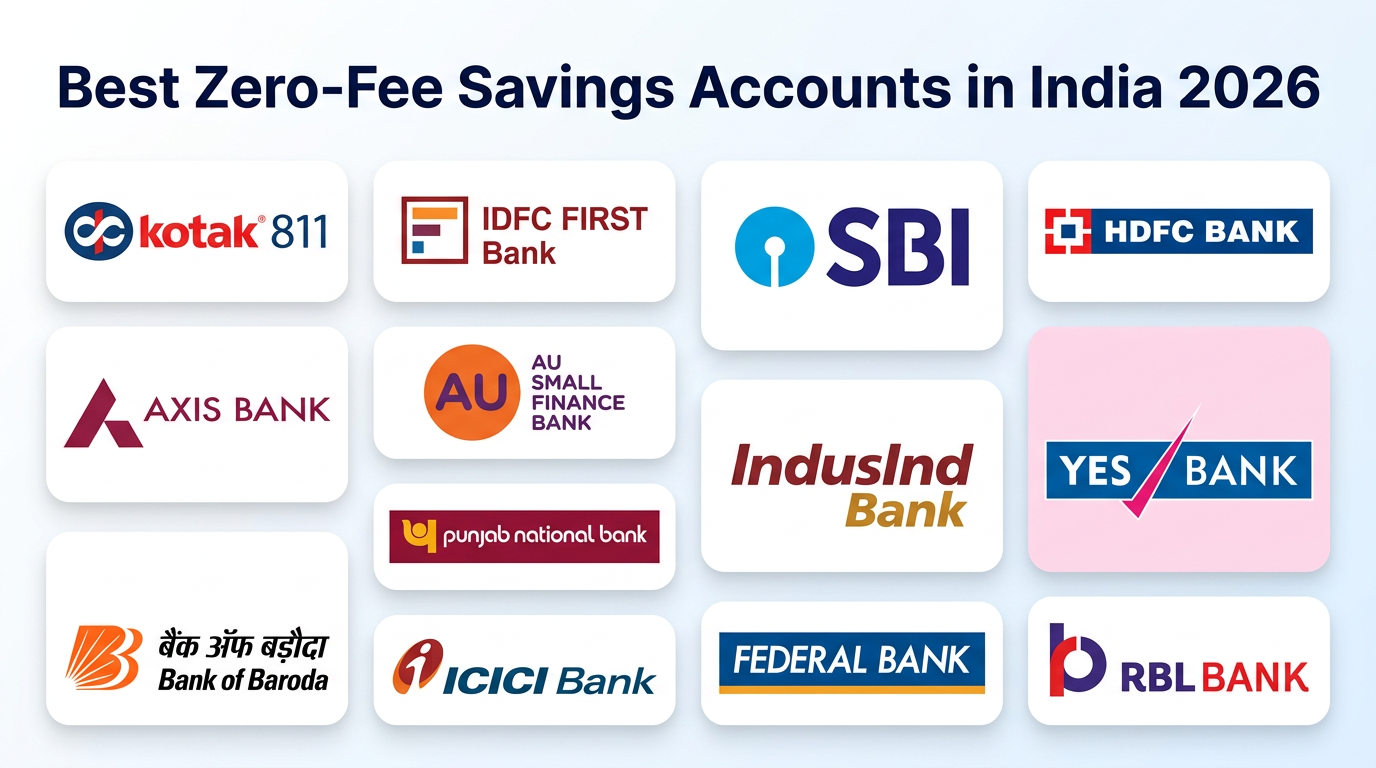
Best Zero-Fee Savings Accounts in India 2026: Your Complete Guide
Introduction
The banking landscape in India has undergone a revolutionary transformation over the past few years. Gone are the days when maintaining a minimum balance was mandatory, with hefty penalties draining your hard-earned money. In 2026, zero-fee savings accounts have become the new normal, offering Indians unprecedented freedom in managing their finances without the anxiety of maintaining minimum balances.
Whether you're a student opening your first bank account, a self-employed professional managing irregular income, or a salaried individual tired of maintaining multiple accounts with different minimum balance requirements, zero-fee savings accounts present an attractive alternative. These accounts eliminate monthly average balance (MAB) requirements, penalty fees, and many service charges that traditional accounts impose.
This comprehensive guide explores the best zero-fee savings accounts available in India in 2026, helping you make an informed decision based on your unique financial needs and lifestyle.
Understanding Zero-Fee Savings Accounts
What is a Zero Balance Account?
A zero balance account, also known as a Basic Savings Bank Deposit Account (BSBDA), is a savings account that requires no minimum balance maintenance. You can keep any amount in your account—even zero rupees—without facing penalties or account closure threats.
The Reserve Bank of India (RBI) introduced BSBDA guidelines to promote financial inclusion, ensuring that every Indian citizen has access to basic banking services regardless of their income level. While initially designed for economically disadvantaged sections, zero balance accounts have evolved to attract mainstream users seeking hassle-free banking.
Key Features of Zero-Fee Accounts
Zero-fee savings accounts typically offer:
• No minimum balance requirement
• No penalty for non-maintenance of balance
• Free debit card issuance
• Complimentary chequebook facilities
• Free NEFT/RTGS/IMPS transactions
• Internet and mobile banking access
• Free ATM withdrawals (with certain limits)
• Competitive interest rates ranging from 2.50% to 7.00% per annum
Traditional vs Zero Balance Accounts
|
Feature |
Traditional Account |
Zero Balance Account |
|
Minimum Balance |
₹5,000 - ₹25,000 |
₹0 |
|
Penalty for Non-maintenance |
₹200 - ₹750/month |
None |
|
Account Opening |
Branch visit often required |
Instant digital opening |
|
Service Charges |
Multiple charges apply |
Most services free |
|
Digital Features |
Basic to Advanced |
Advanced digital-first |
Table 1: Comparison of traditional and zero balance savings accounts
Top 10 Zero-Fee Savings Accounts in India 2026
1. Kotak 811 Digital Savings Account

Figure 1: Kotak 811 Digital Banking
Target Audience: Digital-savvy millennials and Gen Z users
Primary Keyword: Zero balance saving account online
Interest Rate: 3.50% per annum
Kotak 811 has revolutionized digital banking in India by offering a completely mobile-first banking experience. The account can be opened in under 10 minutes through video KYC, eliminating the need for branch visits entirely.
Key Features:
• Instant virtual debit card for immediate online transactions
• Physical card delivery within 7 days
• Free NEFT/RTGS/IMPS transactions
• Integration with UPI for seamless payments
• No hidden charges or penalties
• Monthly account statement via email
Best For: Students, freelancers, and individuals who prefer app-based banking without visiting branches.
2. IDFC FIRST Bank Zero-Fee Savings Account

Figure 2: IDFC FIRST Bank
Target Audience: Professionals seeking premium zero-fee banking
Primary Keyword: Zero fee digital banking India
Interest Rate: Up to 6.50% per annum (varies with balance slab)
IDFC FIRST Bank offers genuine zero-fee banking across all its savings account variants. Unlike competitors who market "zero balance" but charge for services, IDFC FIRST eliminates fees on ATM transactions (even at other banks' ATMs), debit card issuance, chequebooks, and fund transfers.
Key Features:
• Unlimited free ATM withdrawals at any bank's ATM nationwide
• Zero charges on IMPS, NEFT, RTGS, and DD issuance
• Free SMS alerts and account statements
• No non-home branch transaction charges
• Premium debit card benefits
• Interest up to 7% on savings (promotional offers)
Best For: Frequent travelers, professionals who use ATMs extensively, and those seeking comprehensive zero-fee banking.
3. SBI Basic Savings Bank Deposit Account (BSBDA)

Figure 3: State Bank of India
Target Audience: First-time account holders and rural customers
Primary Keyword: SBI zero balance account
Interest Rate: 2.70% per annum
As India's largest public sector bank, State Bank of India (SBI) offers BSBDA to promote financial inclusion. With over 22,000 branches and 62,000+ ATMs across India, SBI provides unmatched accessibility.
Key Features:
• Extensive branch and ATM network nationwide
• No minimum balance requirement
• Free RuPay debit card
• 4 free ATM withdrawals per month at non-SBI ATMs
• Mobile and internet banking facilities
• Chequebook facility available
Best For: Individuals in tier-2 and tier-3 cities, senior citizens, and those preferring traditional banking with extensive branch access.
4. HDFC Bank DigiSave Youth Account

Figure 4: HDFC Bank
Target Audience: Students and young professionals (aged 18-25)
Primary Keyword: Best savings account for students India
Interest Rate: 3.00% per annum
HDFC Bank's DigiSave Youth Account caters specifically to young Indians entering their financial journey. The account balances modern digital features with the trust and reliability of one of India's premier private banks.
Key Features:
• Zero balance requirement for customers aged 18-25
• Contactless debit card with international usage
• Preferential rates on education loans
• Free demand draft and pay orders
• Complimentary accident insurance cover
• Cashback and rewards on debit card usage
Best For: College students, first-time jobbers, and young adults beginning their financial independence journey.
5. Axis Bank AMAZE Zero Balance Account

Figure 5: Axis Bank
Target Audience: Tech-enabled customers seeking rewards
Primary Keyword: Zero balance account with rewards India
Interest Rate: 3.00% per annum
Axis Bank's AMAZE account redefines zero balance banking by combining it with attractive reward programs. While technically charging ₹200 per month or ₹2,200 annually, the account offers benefits worth over ₹11,000, making it a net positive proposition[7].
Key Features:
• 250+ free banking services included
• 2,000 Edge Reward points on spending ₹20,000 monthly
• Free domestic transactions at all Axis Bank ATMs
• Complimentary debit card with annual rewards
• Video KYC for instant account opening
• Integrated with Axis Mobile app for seamless banking
Best For: Shoppers who regularly use debit cards, reward enthusiasts, and customers seeking value beyond basic banking.
6. AU Small Finance Bank Digital Savings Account

Figure 6: AU Small Finance Bank
Target Audience: High-interest seekers and small business owners
Primary Keyword: High interest zero balance account
Interest Rate: 3.50% per annum (up to 7.00% on higher balances)
AU Small Finance Bank specializes in providing higher interest rates compared to traditional banks. Their digital savings account offers zero balance requirements while delivering competitive returns on deposits.
Key Features:
• Interest rates up to 7.00% on balances above ₹1 lakh
• Instant account opening through digital KYC
• Free NEFT/RTGS/IMPS transactions
• Multi-currency forex card facilities
• Priority customer service
• Sweep-in facility for optimizing interest earnings
Best For: Self-employed individuals, freelancers, and savers looking to maximize interest earnings without locking funds in fixed deposits.
7. Kotak Mahindra Bank 811 Edge Account
Target Audience: Mid-income salaried and self-employed individuals
Primary Keyword: Digital savings account India
Interest Rate: 3.50% per annum
Building on the success of Kotak 811, the Edge variant offers enhanced features for customers who maintain moderate balances while still eliminating mandatory minimum balance requirements[3].
Key Features:
• Zero balance account with premium features
• Higher transaction limits compared to basic 811
• Personalized debit card with enhanced security
• Complimentary locker facilities (subject to availability)
• Preferential rates on loans and credit cards
• Relationship manager support
Best For: Established professionals who want flexibility without minimum balance anxiety but desire premium banking features.
8. IndusInd Bank Indus Delite Savings Account

Figure 7: IndusInd Bank
Target Audience: Premium banking customers without balance constraints
Primary Keyword: Premium zero balance account India
Interest Rate: 3.50% per annum
IndusInd Bank positions its Indus Delite account as a premium offering that eliminates minimum balance requirements for select customer segments, particularly salary account holders.
Key Features:
• Zero balance facility for salary account holders
• Airport lounge access privileges
• Free forex services with preferential rates
• Priority customer care and faster loan processing
• Complimentary insurance coverage
• Milestone-based rewards program
Best For: Salaried professionals with corporate tie-ups, frequent travelers, and customers seeking premium perks without minimum balance stress.
9. YES Bank Smart Salary Advantage Account

Figure 8: YES Bank
Target Audience: Salaried employees across organizations
Primary Keyword: Best salary account India zero balance
Interest Rate: 2.50% - 3.00% per annum
YES Bank's Smart Salary Advantage account converts salary credits into banking benefits while maintaining zero balance requirements. The account offers value-added services specifically designed for salaried individual.
Key Features:
• Automatic zero balance conversion for salary accounts
• Personal accident insurance cover up to ₹5 lakhs
• Air accident insurance up to ₹50 lakhs
• Shopping and dining discounts
• Pre-approved loan offers
• Reward points on debit card transactions
Best For: Employees of companies with YES Bank salary partnerships, and professionals seeking insurance coverage bundled with banking.
10. Galgal Digital Savings Account (via Cosmos Bank)

Figure 9: Galgal Neobank
Target Audience: Students and budget-conscious young adults
Primary Keyword: Best banking app for students India
Interest Rate: 3.00% - 4.00% per annum
Galgal represents the new generation of neobank platforms operating through partner banks (Cosmos Bank). It offers AI-powered budgeting tools combined with traditional banking features, specifically designed for students and first-time savers.
Key Features:
• Auto-budgeting and expense tracking
• Platinum rewards on spending
• Instant virtual cards for online shopping
• Savings goals and automated investment options
• No hidden charges or penalties
• Student-friendly interface with financial literacy content
Best For: College students, young professionals learning financial management, and digital-native users seeking smart banking features.
Comprehensive Comparison: Which Account is Best for You?
To help you make the right decision, here's a detailed comparison organized by user profile and needs:
Comparison by User Profile
|
User Type |
Top Choice |
Alternative |
Why |
|
Students (18-25) |
HDFC DigiSave Youth |
Galgal Digital |
Free insurance, education loan benefits, trusted brand |
|
Freelancers |
AU Small Finance |
Kotak 811 Edge |
High interest rates, irregular income friendly |
|
Salaried (Entry) |
YES Bank Salary |
SBI BSBDA |
Bundled insurance, corporate tie-ups |
|
Salaried (Senior) |
IDFC FIRST |
IndusInd Delite |
Premium features, unlimited ATM access |
|
Self-Employed |
AU Small Finance |
IDFC FIRST |
Business-friendly, high interest |
|
Frequent Travelers |
IDFC FIRST |
IndusInd Delite |
Free ATM globally, forex benefits, lounge access |
|
Senior Citizens |
SBI BSBDA |
IDFC FIRST |
Branch access, trusted PSU bank |
|
Digital Natives |
Kotak 811 |
Galgal Digital |
App-first experience, instant opening |
|
Reward Seekers |
Axis AMAZE |
IndusInd Delite |
Points program, cashback offers |
|
Rural Users |
SBI BSBDA |
HDFC Bank |
Extensive branch network |
Table 2: Best accounts by user profile
Feature-Wise Comparison Matrix
|
Feature |
Kotak 811 |
IDFC FIRST |
SBI |
HDFC Youth |
Axis AMAZE |
|
Interest Rate |
3.50% |
6.50% |
2.70% |
3.00% |
3.00% |
|
Free ATM (Others) |
4/month |
Unlimited |
4/month |
5/month |
5/month |
|
Digital Opening |
Yes |
Yes |
Yes |
Yes |
Yes |
|
Branch Access |
Limited |
Good |
Excellent |
Excellent |
Good |
|
Rewards Program |
No |
No |
No |
Yes |
Yes |
|
Insurance |
No |
Optional |
No |
Yes |
Optional |
|
Age Restriction |
None |
None |
None |
18-25 |
None |
|
App Rating |
4.3/5 |
4.2/5 |
3.8/5 |
4.1/5 |
4.0/5 |
Table 3: Feature comparison of top 5 accounts
Interest Rate Comparison Across Balance Slabs
|
Bank |
₹0-25k |
₹25k-1L |
₹1L-5L |
Above 5L |
|
Kotak 811 |
3.50% |
3.50% |
3.50% |
3.50% |
|
IDFC FIRST |
3.00% |
4.00% |
5.50% |
6.50% |
|
SBI BSBDA |
2.70% |
2.70% |
2.70% |
2.70% |
|
AU Small Finance |
3.50% |
4.50% |
6.00% |
7.00% |
|
HDFC Youth |
3.00% |
3.00% |
3.00% |
3.00% |
|
Axis AMAZE |
3.00% |
3.00% |
3.00% |
3.00% |
Table 4: Interest rates across different balance slabs
Transaction Limits Comparison
|
Bank |
Daily ATM Limit |
NEFT/RTGS Free |
Chequebook |
Min. Deposit |
|
Kotak 811 |
₹25,000 |
Unlimited |
Free |
₹0 |
|
IDFC FIRST |
₹1,00,000 |
Unlimited |
Free |
₹0 |
|
SBI BSBDA |
₹10,000 |
Limited |
Free |
₹0 |
|
HDFC Youth |
₹50,000 |
Unlimited |
Free |
₹0 |
|
AU Small Finance |
₹50,000 |
Unlimited |
Free |
₹0 |
|
Axis AMAZE |
₹50,000 |
Unlimited |
Free |
₹0 |
|
YES Bank Salary |
₹40,000 |
Unlimited |
Free |
₹0 |
|
IndusInd Delite |
₹75,000 |
Unlimited |
Free |
₹0 |
|
Galgal Digital |
₹25,000 |
Unlimited |
NA |
₹0 |
Table 5: Transaction limits and services comparison
Overall Scoring: Best for All Classes
Based on comprehensive evaluation across features, accessibility, interest rates, and user benefits:
|
Rank |
Bank |
Overall Score |
Best Feature |
Target Class |
Value Rating |
|
1 |
IDFC FIRST |
9.2/10 |
Zero-fee everything |
All classes |
⭐⭐⭐⭐⭐ |
|
2 |
AU Small Finance |
8.8/10 |
High interest |
Middle/Upper |
⭐⭐⭐⭐⭐ |
|
3 |
Kotak 811 |
8.5/10 |
Digital-first |
Youth/Tech |
⭐⭐⭐⭐ |
|
4 |
SBI BSBDA |
8.3/10 |
Branch network |
Rural/Senior |
⭐⭐⭐⭐ |
|
5 |
HDFC Youth |
8.0/10 |
Youth benefits |
Students |
⭐⭐⭐⭐ |
|
6 |
Axis AMAZE |
7.8/10 |
Rewards |
Urban shoppers |
⭐⭐⭐ |
|
7 |
IndusInd Delite |
7.5/10 |
Premium perks |
Professionals |
⭐⭐⭐⭐ |
|
8 |
Galgal Digital |
7.2/10 |
AI budgeting |
Gen Z |
⭐⭐⭐ |
|
9 |
YES Bank Salary |
7.0/10 |
Insurance |
Salaried |
⭐⭐⭐ |
|
10 |
Kotak 811 Edge |
6.8/10 |
Premium 811 |
Mid-income |
⭐⭐⭐ |
Table 6: Overall ranking for all user classes
Winner by Category
🏆 Best Overall for All Classes: IDFC FIRST Bank
· Truly zero-fee across all services
· Unlimited free ATM withdrawals (even other banks)
· High interest rates with tiered structure
· Suitable for students to senior citizens
🥇 Best for Students: HDFC DigiSave Youth Account
· Age-specific benefits (18-25)
· Education loan advantages
· Free accident insurance
· Trusted brand with digital features
🥈 Best for Professionals: IDFC FIRST Bank / AU Small Finance
· IDFC for frequent travelers and ATM users
· AU for maximizing interest on savings
🥉 Best for Rural/Tier-2-3 Cities: SBI BSBDA
· Unmatched branch and ATM network
· Government-backed security
· Accessible to everyone
💰 Best Interest Rates: AU Small Finance Bank
· Up to 7% per annum on higher balances
· Sweep-in facility for optimization
🎁 Best Rewards Program: Axis Bank AMAZE
· 2,000 reward points monthly
· Benefits worth ₹11,000+ annually
📱 Best Digital Experience: Kotak 811 / Galgal
· Kotak for mainstream banking
· Galgal for AI-powered features
How to Choose the Right Zero-Fee Account for Your Needs
For Students and First-Time Account Holders
If you're opening your first savings account, prioritize:
1. Simple account opening process (preferably digital KYC)
2. Educational resources and financial literacy content
3. Low or zero documentation requirements
4. Student-specific benefits like free forex cards or insurance
5. Parental control features if under 18
Recommended Options: HDFC DigiSave Youth, Galgal Digital Account, SBI BSBDA
For Salaried Professionals
Working professionals should look for:
1. Integration with salary processing
2. Quick loan pre-approval facilities
3. Premium features like lounge access or insurance
4. Reward programs that align with spending patterns
5. Efficient customer support
Recommended Options: YES Bank Smart Salary, IndusInd Indus Delite, IDFC FIRST Zero-Fee Account
For Self-Employed and Freelancers
Entrepreneurs and freelancers benefit from:
1. Higher interest rates to maximize idle funds
2. No penalties for irregular deposits
3. Business-linked features like invoicing or payment links
4. Multiple beneficiary management
5. Sweep-in facilities for better returns
Recommended Options: AU Digital Savings, Kotak 811 Edge, IDFC FIRST Bank
For Frequent Travelers
Travelers need accounts with:
1. Free ATM withdrawals nationwide and internationally
2. Forex services with competitive rates
3. Airport lounge access
4. Travel insurance bundled with debit card
5. Multi-currency support
Recommended Options: IDFC FIRST Bank, IndusInd Indus Delite, Axis AMAZE
Understanding Neobanks vs Traditional Banks in 2026
What Are Neobanks?
Neobanks are digital-only financial platforms that offer banking services without physical branches. In India, neobanks like Jupiter, Galgal, and RazorpayX operate in partnership with RBI-regulated banks since they don't hold independent banking licenses.
Regulatory Landscape
As of March 2026, the Reserve Bank of India has not issued full banking licenses to standalone neobanks. These platforms operate through Prepaid Payment Instrument (PPI) licenses and partnerships with licensed banks. The RBI continues to evaluate a two-tier licensing framework that could allow qualified fintechs to graduate into phased banking operations.
Key Regulatory Points:
• All deposits are held with partner banks (SBI, ICICI, Axis, Federal Bank, etc.)
• Consumer protection falls under partner bank's RBI license
• Cybersecurity standards must match traditional banking requirements
• Data localization rules mandate onshore storage of financial information
Advantages of Neobank Accounts
• Superior user interface and mobile app experience
• AI-powered financial insights and budgeting tools
• Faster innovation in features and services
• Lower operational costs translated to better interest rates
• Seamless integration with payment platforms and fintech services
Traditional Bank Advantages
• Extensive branch network for in-person service
• Direct RBI regulation and century-long track records
• Comprehensive product suite (loans, insurance, investments)
• Physical presence for document verification and complex transactions
• Established dispute resolution mechanisms
Step-by-Step Guide: Opening a Zero Balance Account Online
Opening a zero-fee savings account in 2026 is remarkably simple thanks to Video KYC technology approved by the RBI. Here's the complete process:
Step 1: Choose Your Bank
Research and select the bank that best matches your requirements using the criteria discussed earlier. Visit their official website or download their mobile application.
Step 2: Start the Application
Navigate to the "Open Account" or "New Savings Account" section. Select the zero balance or basic savings account option.
Step 3: Provide Basic Information
Fill in the online form with:
• Full name (as per government ID)
• Date of birth
• Mobile number (OTP verification required)
• Email address
• Current residential address
• Employment status
Step 4: Upload Documents
Scan and upload required documents:
• PAN card (mandatory for all accounts)
• Aadhaar card (for e-KYC and address proof)
• Recent photograph (in some cases)
• Signature specimen (digital capture)
Step 5: Video KYC Verification
Schedule or immediately join a video call with the bank's verification officer. Keep your original documents ready. The officer will:
• Verify your identity by comparing live video with photo ID
• Confirm your PAN and Aadhaar details
• Record a short video statement
• Verify your current location
This process typically takes 5-15 minutes.
Step 6: Account Activation
Once KYC is approved (usually within 24-48 hours), you'll receive:
• Account number via SMS and email
• Customer ID and internet banking credentials
• Mobile banking app login details
• Virtual debit card (instant issuance)
• Physical debit card dispatched to your address
Step 7: Initial Deposit and Setup
Make your initial deposit (if required—some accounts need ₹500-₹1,000 to activate). Set up:
• UPI PIN for your new account
• Nominee details for account succession
• Standing instructions or auto-debit mandates if needed
• Preferred communication channels
Frequently Asked Questions
Q1: Are zero balance accounts completely free?
Most services are free, including account maintenance, debit card issuance, and basic transactions. However, some banks may charge for services like physical statement copies, international transactions, or exceeding free ATM withdrawal limits.
Q2: What is the difference between zero balance and minimum balance accounts?
Zero balance accounts require no minimum balance maintenance and impose no penalties for low balances. Minimum balance accounts require maintaining an average monthly balance (typically ₹5,000-₹25,000) and charge penalties if you fall below this threshold.
Q3: Can I convert my existing regular savings account to a zero balance account?
Yes, most banks allow conversion to zero balance variants. Contact your bank's customer service or visit your home branch with your account details. Some banks may restrict conversions based on account type or eligibility criteria.
Q4: Do zero balance accounts earn interest?
Yes, zero balance accounts earn interest on the balance you maintain, typically ranging from 2.50% to 7.00% per annum depending on the bank and balance slab. Interest is calculated daily and credited quarterly.
Q5: Are there any transaction limits on zero balance accounts?
Basic savings accounts (BSBDA) mandated by RBI have certain limits: maximum balance of ₹50,000 (some banks offer ₹1 lakh) and aggregate credits of ₹1 lakh per year. Enhanced zero balance accounts from private banks typically don't have these restrictions.
Q6: Can NRIs open zero balance accounts?
No, zero balance accounts are generally available only to resident Indians. Non-Resident Indians (NRIs) need to open NRE or NRO accounts which have different requirements and cannot be zero balance accounts.
Q7: How safe are neobank zero balance accounts?
Neobanks in India operate through partnerships with RBI-regulated banks. Your deposits are held with these partner banks, not with the neobank itself. Therefore, they carry the same safety and deposit insurance (up to ₹5 lakhs per depositor under DICGC) as traditional bank accounts.
Q8: Can I have multiple zero balance accounts?
Yes, you can open zero balance accounts with different banks. However, KYC requirements mean all accounts will be linked through your PAN and Aadhaar, and tax authorities can track all your accounts for compliance purposes.
Q9: Which bank offers the highest interest rate on zero balance accounts?
AU Small Finance Bank offers the highest interest rates, up to 7.00% per annum on balances above ₹1 lakh. IDFC FIRST Bank also offers competitive rates up to 6.50% on higher balance slabs.
Q10: What is the best zero balance account for all types of users?
IDFC FIRST Bank Zero-Fee Savings Account is the most versatile option suitable for all classes—students, professionals, self-employed, and seniors. It offers truly zero fees on all services, unlimited free ATM withdrawals, and competitive interest rates.
Tips for Maximizing Benefits from Zero Balance Accounts
1. Leverage Free Services Fully
Take advantage of unlimited free NEFT/RTGS transfers to consolidate funds from multiple accounts without incurring charges.
2. Use Sweep-in Facilities
Some zero balance accounts offer sweep-in features where excess funds automatically move to fixed deposits earning higher interest, while maintaining liquidity.
3. Optimize Reward Programs
If your zero balance account offers reward points (like Axis AMAZE), align your regular spending through the debit card to accumulate maximum benefits.
4. Set Up Auto-savings
Use standing instructions to automatically transfer a fixed amount to recurring deposits or mutual funds, building disciplined savings habits.
5. Monitor Your Credit Score
Many banks offer free credit score tracking. Regular monitoring helps you identify issues early and maintain good credit health for future loan applications.
6. Utilize Financial Planning Tools
Neobanks and digital accounts often include budgeting, expense tracking, and goal-setting features. Use these to develop better financial habits.
7. Link Multiple Payment Methods
Connect your account to UPI apps (Google Pay, PhonePe, Paytm), payment wallets, and investment platforms for seamless money management.
8. Take Advantage of Promotional Offers
Banks frequently run promotional campaigns offering higher interest rates, cashback, or bonus reward points. Stay informed through SMS alerts and app notifications.
9. Utilize Insurance Benefits
If your account includes complimentary insurance (accident, travel, or purchase protection), understand the coverage details and claim process to maximize value.
10. Build Banking Relationship
Regular usage and maintaining healthy balances can lead to pre-approved loan offers, preferential interest rates, and invitations to premium account upgrades.
The Future of Zero-Fee Banking in India
Digital-First Evolution
By 2026, the majority of account openings happen digitally. Banks are investing heavily in AI-powered chatbots, voice banking, and biometric authentication to enhance user experience while reducing operational costs.
Open Banking and API Integration
The Account Aggregator framework launched by RBI is enabling secure data sharing between financial institutions. Zero balance account holders can now seamlessly access credit, insurance, and investment products based on their banking data without extensive documentation.
Embedded Finance
Zero balance accounts are increasingly integrating with e-commerce platforms, gig economy apps, and digital lending platforms. Freelancers on platforms like Upwork or Fiverr can receive international payments directly into specially designed zero balance accounts with competitive forex rates.
Cryptocurrency and Blockchain Integration
While India's regulatory stance on cryptocurrencies remains cautious, several banks are exploring blockchain for faster settlements and reduced transaction costs. Some fintechs are testing crypto-linked savings products through their partner banks.
Hyper-Personalization
Advanced analytics allow banks to offer customized products. Your zero balance account might automatically suggest investment opportunities based on spending patterns, or alert you to subscription services you no longer use.
Sustainability-Linked Banking
Several banks now offer "green" zero balance accounts where a portion of the bank's profits from your account is invested in environmental or social projects, appealing to conscious consumers.
Voice and Conversational Banking
Voice-activated banking through smart speakers and AI assistants is becoming mainstream. Users can check balances, make transfers, and pay bills through natural language commands.
Unified Payment Interfaces
UPI continues to evolve with features like UPI Lite for small-value transactions, UPI for credit cards, and international UPI acceptance, making zero balance accounts even more versatile.
Conclusion
Zero-fee savings accounts have democratized banking in India, eliminating the financial stress of maintaining minimum balances while offering feature-rich experiences that rival premium accounts. Whether you're a student taking your first step toward financial independence, a professional managing complex finances, or a freelancer with irregular income, there's a zero balance account designed for your needs.
Final Recommendations:
For Universal Appeal: IDFC FIRST Bank stands out as the best overall choice for all classes of users, offering genuinely zero fees across all services, unlimited free ATM access, and competitive interest rates.
For Maximum Returns: AU Small Finance Bank is ideal for savers who want to earn the highest interest (up to 7% p.a.) while maintaining complete liquidity.
For Students: HDFC DigiSave Youth Account provides age-specific benefits, insurance coverage, and educational loan advantages that make it perfect for young adults.
For Rural India: SBI BSBDA remains the most accessible option with its unparalleled branch network and government-backed security.
For Digital Natives: Kotak 811 and Galgal offer cutting-edge digital experiences with AI-powered features and instant account opening.
The key to choosing the right account lies in understanding your banking habits, transaction patterns, and future financial goals. Digital-first options like Kotak 811 and Galgal offer unmatched convenience for tech-savvy users, while traditional giants like SBI provide the security of extensive branch networks. Premium offerings from IDFC FIRST and IndusInd eliminate virtually all banking charges while delivering value-added services.
As we move further into 2026, the distinction between neobanks and traditional banks continues to blur. What remains constant is the consumer-first approach driven by competition and regulatory support for financial inclusion. Take the time to evaluate options using the comparison tables provided, leverage the digital account opening processes, and choose an account that aligns with your lifestyle and financial goals.
The era of paying banks to hold your money is over. Welcome to the age of zero-fee banking—where your money works for you, not the other way around.
References
[1] BankBazaar. (2025). Best Zero Balance Savings Account in India 2026. https://www.bankbazaar.com/savings-account/best-zero-balance-savings-account-for-indian-citizens.html
[2] ClearTax. (2025). Best Zero Balance Savings Account In India. https://cleartax.in/s/best-zero-balance-account-in-india
[3] Asianet News. (2026, February 23). Best Savings Account in India 2026: Top 10 Banks Compared. https://www.asianetnews.com/finance/best-savings-account-in-india/
[4] IDFC FIRST Bank. (2024). Savings Account - Open Bank Account Online Instantly. https://www.idfcfirst.bank.in/personal-banking/accounts/savings-account
[5] 5paisa. (2026, February 26). Best Savings Bank Accounts in India 2026 – Top Banks Compared. https://www.5paisa.com/blog/best-savings-bank-accounts-in-india
[6] Galgal Money. (2026, February 8). Zero Balance Accounts in India: Complete guide(2026). https://www.galgal.money/zero-balance-accounts-india/
[7] Axis Bank. (n.d.). Open Zero Balance Savings Account Online. https://www.axisbank.com/retail/accounts/savings-account/amaze-zero-balance-savings-account
[8] Paisabazaar. (2026, February 17). Top Zero Balance Savings Accounts in India for 2025. https://www.paisabazaar.com/savings-account/top-zero-balance-savings-account/
[9] YouTube. (2026, January 22). Top 6 Best Zero Balance Bank Accounts in 2026. Sarkari DNA. https://www.youtube.com/watch?v=T-lEXegmewM
[10] ClearTax. (2025). Best Zero Balance Savings Account In India. https://cleartax.in/s/best-zero-balance-account-in-india
[11] Galgal Money. (2026, February 8). Zero Balance Accounts in India: Complete guide(2026). https://www.galgal.money/zero-balance-accounts-india/
[12] Fortune India. (2025, April 15). No RBI licence, all digital: Can you really trust neo banks with your money. https://www.fortuneindia.com/personal-finance/banking/no-rbi-licence-all-digital-can-you-really-trust-neo-banks-with-your-money/
[13] Billcut. (2025, November 6). Will the Reserve Bank of India License the Next Wave of Neobanks. https://www.billcut.com/blogs/will-rbi-license-the-next-wave-of-neobanks/